




What damages your skin microbiome? It's rarely one product or one bad day. It's usually a mix of everyday habits: washing a little too often, reaching for a cleanser that's too harsh, layering on more actives than your skin can handle. Add in UV exposure, pollution, stress, poor sleep, and the occasional course of antibiotics, and it's no wonder your skin sometimes feels like it's fighting back.
Here's the thing: your skin microbiome and your skin's surface barrier are deeply connected. When one gets thrown off balance, the other usually follows close behind. So skin microbiome disruption often shows up as barrier symptoms you already recognize: tightness, sensitivity, dullness, that "off" feeling that's hard to put your finger on.
Below, we're breaking down the real causes behind a damaged skin microbiome, what each one does to your skin's surface, and how to help things bounce back. Gently, of course. That's kind of our whole thing.
What Your Skin Microbiome Actually Does
Before we get into what disrupts it, let's talk about what your skin's natural ecosystem actually does.
Your skin plays host to a living ecosystem that works around the clock right on its surface. Together, it helps hold your skin at its naturally slightly acidic pH of around 5 (often called the acid mantle). It also helps your skin's surface stay resilient against outside stressors, working alongside your skin's own natural defenses to help it feel calm, balanced, and supported day to day.
What matters most here is its balance and diversity. Researchers call a disruption to that balance dysbiosis, or skin dysbiosis, more specifically: a shift in your skin's ecosystem rather than that ecosystem simply being wiped out.
Over-Cleansing and Harsh Cleansers
Over-cleansing your skin microbiome tends to happen slowly, one extra wash at a time. If you only change one thing after reading this, make it your cleanser, or how often you're reaching for it. This is the most controllable cause of skin microbiome disruption on this list, and the one most people don't even realize they're doing.
Cleansers, soaps, and abrasive scrubs can have a pretty immediate effect on your skin microbiome. And it's because they can remove what your skin's natural ecosystem depends on to stay balanced. Over-wash, especially with something harsh, and you start stripping away the oils your skin needs. Harsh cleansers and your skin’s natural ecosystem simply don't get along, which is exactly why gentle formulas matter so much here.
Dermatologists keep the guidance pretty simple: wash your face no more than twice a day (plus after sweating), reach for a gentle, non-abrasive cleanser without alcohol, and apply it with your fingertips rather than a washcloth or mesh sponge, since those can irritate your skin.
Water temperature and how you dry off matter too. Lukewarm water and a soft towel are much gentler on your skin than hot water and a vigorous rub-down, and that adds up fast when you're doing it twice a day, every day.
To be clear, this isn't an argument for skipping cleansing altogether. Under-washing brings its own problems (more on that below). The fix is almost always switching to a gentler daily cleanser, like The Cult Classic, and cleansing a little less often, not stopping.
Why Cleanser pH Matters
Your skin's happiest, most balanced state sits at a slightly acidic pH of around 5. Most cleansers and soaps on the market are alkaline, usually somewhere between pH 7 and 8, because that's the range surfactants and emulsifiers tend to work best in. When your skin's pH climbs too high, too often, it can throw off your skin's natural balance and put extra strain on your surface barrier.
Your skin does bounce its pH back between washes, so one alkaline cleanse isn't the end of the world. It's repeated use that adds up, partly because it can wear down your skin's ability to recover its pH in the first place. Look for a cleanser described as pH-balanced or gentle.
Over-Exfoliation and Too Many Actives at Once
Exfoliation isn't the villain here. Neither are actives. Frequency and stacking are.
Physical scrubs and chemical exfoliants both speed up how quickly your skin sheds its outer layer. Do that faster than your skin can keep up, and you thin out the very surface your microbiome calls home. The habitat gets smaller and less stable, and the oils that support it drop right along with it. That's over-exfoliating your skin barrier, in a nutshell.
Stacking makes it worse. An acid in the morning, a retinoid at night, and a vitamin C serum somewhere in between are all working the same square inch of skin at the same time. Any one of them might be totally fine on its own. Together, they rarely give your skin a day off.
If your routine has grown to three or four actives, try subtraction instead of addition. Pull back to one, give it two weeks, and see how your skin actually feels. Comfort and texture usually tell you more than your ingredient list ever will.
Ingredients That Can Throw Off Your Skin's Balance
Cosmetic products often contain preservatives, which interact with your skin's natural ecosystem as well as with your skin itself. Preservatives exist for good reason (a product that grows unwanted microbes in the jar is a real safety issue), but by nature, they're not selective about what they affect.
High concentrations of alcohol tend to sit in a slightly different category. These are more of an irritation and barrier issue than anything else. And a stressed-out barrier is a much less comfortable place for your skin's natural ecosystem to thrive.
More broadly, harsh chemicals and certain medications are known to shift your skin's natural balance over time. Using a huge number of products at once has also been linked to less microbial diversity, which is exactly why simplifying your routine is often a good move.
Environmental Stressors: UV, Pollution and Climate
This is the category you control the least. The good news? A little protection goes a long way.
Research on skin dysbiosis lists UV radiation and pollution among the biggest external causes, right alongside cosmetics and diet. UV rays affect your skin’s natural ecosystem, not just your skin cells, which is a slightly different way to think about sun protection than most of us grew up with.
Air pollution deposits tiny particles on your skin's surface, and that's been linked to a more fragile, less stable microbial network. Cities really are harder on your skin than the countryside, and not just in the ways you can see.
Climate plays a role too. Cold, dry air lowers your skin's hydration, while heat and humidity create a totally different environment for microbial growth. If your skin feels like a different organ in January than it does in July, this is a big part of why.
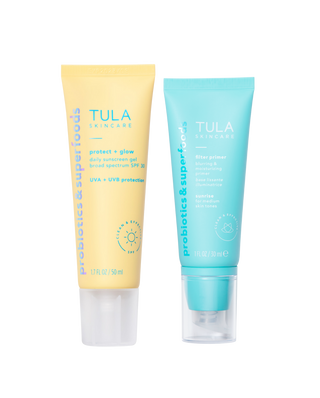
The fix here is refreshingly simple: daily broad-spectrum sunscreen, like Protect + Glow SPF 30, and a proper cleanse in the evening to remove the day's buildup.
Lifestyle Factors: Stress, Sleep, Diet and Antibiotics
What's happening inside your body shows up on your skin's surface too, though the evidence here varies quite a bit in strength. So it’s worth being clear about what's well established and what isn't.
The research that covers UV and pollution also lists stress, hormonal changes, and aging among the internal factors at play. That's a real finding, but a broad one. It won't tell you exactly how much a rough couple of weeks at work is affecting your own skin.
Antibiotics are the clearest example, as they can cause short-term changes to your skin's natural balance. If you've finished a course of antibiotics and your skin has felt different since, you're not imagining it.
The gut-skin connection (the idea that your gut and your skin are in constant communication) is a really fascinating area of ongoing research, but it's not settled science yet. It’s worth keeping an eye on, but not worth overhauling your routine over just yet.
One important thing: if you're on a prescribed medication, this isn't a reason to stop taking it. That conversation belongs with your doctor.
Signs of a Damaged Skin Microbiome
There's no at-home test for this, so what you're really looking for is a pattern, not one single symptom.
The signs people report most often: persistent dryness or tightness, new sensitivity that wasn't there before, redness, dullness, and congestion that doesn't respond to a routine that used to work just fine. You'll notice these overlap almost completely with the signs of a compromised skin barrier, and that's expected. Your skin microbiome and skin barrier tend to run into trouble together, each one making the other more likely.
Timing is your best clue. Symptoms that started right after a routine change, a new active, a move, or a course of medication point to a cause you can actually do something about. Symptoms with no obvious trigger are trickier to read.
If any of this feels persistent, painful, or like it's getting worse, see a board-certified dermatologist instead of troubleshooting it solo.
How to Restore Your Skin Microbiome
Recovery is subtraction first, addition second. Most people show up wanting to add a product. The more useful first move is almost always taking one away.
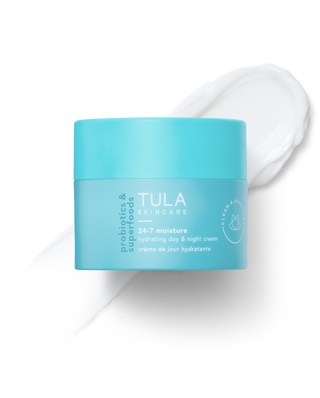
Here's the sequence: pause exfoliants and any non-essential actives completely. Cleanse once at night with something gentle, and just rinse with water in the morning if your skin is feeling fragile. Moisturize morning and night, using formulas made to support a stressed skin barrier. Then bring actives back one at a time, leaving a couple of weeks between each one, so if something doesn't agree with your skin, you'll know exactly what it was.
Give it weeks, not days. Your skin recovers on its own timeline, and showing up consistently matters more than doing "more."
At TULA, our formulas with prebiotics are designed to support your skin's natural ecosystem, not override it. Prebiotics are ingredients that help create an environment where your skin's microbiome can stay balanced, giving your skin's surface barrier what it needs to feel calm and function the way it should. Our formulas hydrate to nourish and help balance the skin microbiome, supporting your skin's surface barrier one product at a time.
One thing worth saying plainly: no single product can repair, heal, or single-handedly rebalance your skin microbiome overnight. What a good, prebiotic-formulated routine can do is support your skin's natural systems and stop making things harder on it, which, honestly, is most of the job.
Frequently Asked Questions
How long does it take for the skin microbiome to recover?
Recovery is generally measured in weeks, not days, and the exact timeline depends on what caused the disruption and how long it went on. Dryness and sensitivity tend to improve first. Staying consistent with a simple routine matters more than piling on new products.
Does hard water affect the skin microbiome?
Hard water leaves more minerals on your skin and makes it harder to rinse cleansers away completely, both of which can change conditions at your skin's surface. The research here is less developed than it is for cleansers or UV exposure, so think of this as plausible rather than firmly proven.
Can you wash your face too little?
Yes. Under-cleansing lets sweat, oil, makeup, and pollution build up on your skin, which changes your skin's surface in its own way. The goal is appropriate cleansing, not minimal cleansing, which for most people means once or twice a day and after sweating.
Is the skin microbiome the same as the skin barrier?
No, though the two are closely linked. Your skin's surface barrier is the physical structure of your outermost skin layer, while your skin microbiome is the natural ecosystem living on top of it. Skin microbiome and skin barrier health tend to go hand in hand, which is why damage to one so often shows up as symptoms people blame on the other.
Finding Your Skin’s Balance
If there's one thread running through all of this, it's that your skin responds better to being supported than to being worked on. A gentler routine usually outperforms a longer one, and that's the whole philosophy behind how we formulate.
Our prebiotic skincare collection is a good place to start. Not a fix. Not a reset. Just a simpler set of prebiotic-formulated products to help you build back once you've taken a few things away. Not sure where to start? Take the Skin Quiz and we'll help you find your next move.


