




Are Prebiotics Safe For Sensitive Skin?
Yes. Prebiotics are widely considered safe for skin, sensitive and reactive types included, and they're a big part of why we formulate with prebiotics. They're non-living ingredients, usually sugars and plant-derived fibers, that support the beneficial part of your skin's natural ecosystem that's already there, rather than introducing anything new to your skin's surface.
That's what makes prebiotic skincare such a reasonable place to start if your skin reacts easily. But before you shop by ingredient alone, it’s worth pointing out that safety is a property of the whole formula, not any single ingredient in it. A formula with prebiotics sitting next to something like a strong acid, for example, can still cause a reaction (especially since sensitive skin is usually working with a more delicate surface barrier that lets irritants in more easily than average).
What Prebiotics Actually Do in Skincare
Most people meet prebiotics in the wellness aisle first, as the fiber that supports a healthy gut. On skin, the idea carries over. Prebiotics are ingredients that support your skin's natural ecosystem and help create an environment where your skin can look and feel its best. The names you'll actually spot on an ingredient list tend to be inulin (often derived from chicory root) and other oat- or plant-derived compounds.
The important part for sensitive skin is what prebiotics are not. They're non-living, so there's nothing to keep stable in the bottle, which makes them simpler and more consistent to formulate with than live cultures. They're also not actives in the way an acid or a retinoid is. A prebiotic isn't exfoliating anything or speeding up cell turnover. It's simply supporting what's naturally on your skin's surface.
And your skin's natural ecosystem sits on the outermost layer of skin, working alongside your skin surface barrier (rather than replacing it). That barrier is part of your stratum corneum, which is the outer layer made up of dead cells, lipids, proteins and fats, doing the job of keeping water in and keeping chemicals out. Your skin's ecosystem living on top of that barrier is a separate system doing related work, which is why "microbiome" and "barrier" tend to get mentioned in the same breath, even though they're not quite the same thing – because they work together.
Why Sensitive Skin Reacts in the First Place
Sensitive skin describes how skin behaves, not a medical diagnosis. What usually sits underneath it is a more delicate surface barrier. When that outer layer isn't doing its job, irritants get in more easily and water escapes faster, a process called transepidermal water loss, or TEWL.
Stinging when you apply skincare, along with tenderness, itchiness and flaking, are some of the signs of a damaged skin barrier. Redness that lingers, which dermatologists call erythema, is one of the more visible signs, though sensitivity is just as often something you feel rather than something anyone else can see.
Several everyday habits chip away at your skin surface barrier. Harsh soaps strip the natural oils that hold it together (the ceramides, cholesterol and fatty acids that act like mortar between skin cells). Over-exfoliating does much the same. Skin pH sits at around 5.5 when things are balanced, and that acid mantle is easy to disturb.
There's a skin microbiome and sensitive skin connection too, and it's newer research. Studies point to the balance of your skin's ecosystem as one contributing factor alongside barrier impairment and heightened nerve response, which is part of why microbiome-focused formulation has become such an active research area for this skin type.
Redness, stinging or flaking that persists is worth raising with a dermatologist rather than solving with a product. Conditions like rosacea and eczema can present as general sensitivity and are managed differently.
So, Are Prebiotics Safe for Sensitive Skin?
Prebiotics are widely considered well tolerated on sensitive skin, and the reasoning definitely holds up once you know what they are.
Two things do most of the work. First, prebiotics are non-living, so there's no question of introducing anything new to an already reactive surface. Second, they're not actives. Acids exfoliate. Retinoids speed up turnover. Both can sting on sensitive skin, by design. A prebiotic does neither. It supports what's already there, which is a much gentler ask of a delicate barrier.
That said, a little caution with any new product, prebiotic or otherwise, is sensible for skin that’s more on the sensitive side. There are other ingredients that could still irritate. A good scan of the ingredient list and patch test is always a good idea.
When Prebiotic Products Do Cause Irritation
Some people do experience prebiotic skincare side effects. But when a prebiotic formula causes redness, itching or stinging, the prebiotic itself is very rarely the culprit. It's almost always something else in the same bottle.
A skincare ingredient, such as one of the preservatives, can trigger allergic contact dermatitis, which shows up as red, itchy, swollen skin. Strong actives like high-strength alpha hydroxy acids and retinoids are the other usual suspects.
This is why the word "prebiotic" on the front of a bottle tells you very little on its own about whether prebiotics are safe for skin like yours specifically. It describes one ingredient in a formula that might contain thirty others. If fragrance is what your skin tends to react to, fragrance-free formulas are the thing to look for, whether or not they also happen to be formulated with prebiotics.
It's also worth separating two different experiences. Mild tightness for a day or two after switching products is common and usually settles on its own. Persistent burning, swelling or a rash that spreads isn't an adjustment period, that's contact irritation, and the right response is to stop using the product rather than push through it. There's no "purging" phase to earn with a gentle formula.
How to Read the Rest of the Ingredient List
Prebiotics usually sit in the middle or lower half of an INCI list, and that's normal. Ingredient lists run roughly in order of concentration, so anything near the end is present in a smaller amount.
The names to look for include inulin, alpha-glucan oligosaccharide, beta-glucan and other oat-derived compounds. Those are what will actually show up on the label.
The most useful list, though, is your own. If you already know which specific ingredients have caused you trouble before, scan for those rather than judging a product by its category.
Building a Gentle Prebiotic Routine for Sensitive Skin
The minimum that works for reactive skin is three steps: a gentle cleanser, a moisturizer, and a broad spectrum sunscreen in the morning. Prebiotics can sit in any or all of them; there's no single "correct" step for a prebiotic to live in. The order is simple. Cleanse, apply anything that goes on damp skin, then moisturizer, then sunscreen last in the morning.
Fewer products is usually the better call. Every additional formula is another set of ingredients for your skin to tolerate, and the more you layer, the harder it becomes to work out what went wrong if something does.
Our approach to this routine leans on three everyday essentials, each formulated with prebiotics:
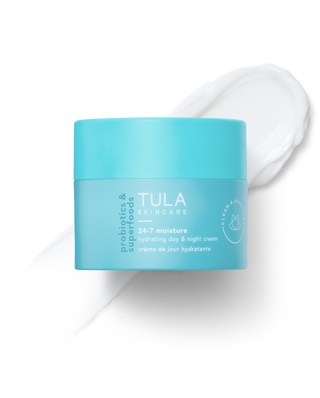
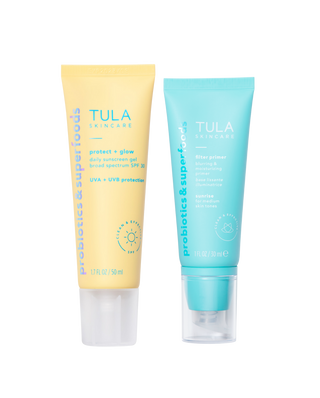
The Cult Classic, a prebiotic cleanser for sensitive skin that cleanses to purify the skin microbiome while washing away makeup, dirt and oil; 24-7 Moisture, a prebiotic moisturizer for sensitive skin that hydrates to nourish the skin microbiome and support the look of a stronger, healthier-looking barrier; and Protect + Glow SPF 30, a broad spectrum sunscreen for the last step of your morning routine.
Frequently Asked Questions
Can prebiotics make sensitive skin worse?
Rarely. Prebiotics are among the gentler ingredients in skincare, and on their own they don't tend to be what makes skin react. But the product they sit in can still cause one, so it would likely be a preservative or a strong active elsewhere on the ingredient list, not the prebiotic-formulated part of it.
Are prebiotics safe to use during pregnancy?
Topical prebiotics aren't among the ingredients usually flagged during pregnancy, but check with your healthcare provider before changing your routine. The caution during pregnancy generally attaches to other ingredients that might be in the same product, retinoids being the most common example.
Do you need probiotics too, or are prebiotics enough on their own?
Prebiotics work perfectly well on their own. The more useful question isn't which of the two is "better," it's whether the whole formula suits your skin. What sits alongside the prebiotic matters too.
A Routine Your Skin Can Trust
If your skin has burned you before, the caution you're carrying is totally normal. Nothing here changes that, and it shouldn't.
What it can change is where you point that caution. Not at the word "prebiotic" on the front of a bottle, but at the ingredient list on the back, and at whether you've actually patch tested before committing to anything new.
If you want somewhere to start, our sensitive skin range is built for exactly this. Our formulas with prebiotics are doctor-founded, science-backed and formulated with prebiotics + skin actives to support a balanced microbiome and barrier for a healthy-looking glow that shines through.
Shop the sensitive skin collection.
Not sure where to begin? The skin quiz narrows it down in a couple of minutes.


