




You finally find a product with a scent you love, and then your skin pushes back. That’s a good enough reason to wonder whether fragrance is bad for sensitive skin.
The truth is that, in certain cases, yes, it can be. Fragrance is one of the most common causes of skin irritation and allergic contact dermatitis, which is why dermatologists often steer sensitive, reactive or eczema-prone skin toward fragrance-free products. That said, fragrance in skincare isn’t a problem for everyone. Whether it bothers you comes down to your skin, the type of product and how often your skin is exposed to it.
Labels can make this trickier than it should be, too, since “fragrance-free” and “unscented” don’t mean the same thing.
Below, we’re breaking down what actually counts as fragrance, why reactive skin responds to it, how to read a label like a pro, and how to build a fragrance-free routine that feels easy instead of overwhelming. You can take a look at our fragrance-free skincare if you want to skip ahead.
What Counts as Fragrance in Skincare?
Fragrance gets added to skincare for one of two reasons: to make a product nicer to use, or to mask the natural scent of other ingredients. Either way, it usually shows up as one of these:
Synthetic fragrance: aroma chemicals made in a lab.
Natural fragrance: scent compounds taken from plants, flowers or fruit.
Essential oils: concentrated plant oils, often added purely for scent.
Masking agents: ingredients used to neutralize an odor rather than add one.
One small word on a label can cover a lot of ground. Under U.S. rules, fragrance ingredients can simply be listed as “Fragrance” or “Parfum,” because fragrance formulas are complex mixtures of natural and synthetic ingredients that are treated as trade secrets. So a single “fragrance” or “parfum” entry on a skincare label can stand in for a whole blend of individual aroma chemicals you’ll never see spelled out.
It’s also worth knowing that “natural” doesn’t automatically mean gentler, which matters when it comes to essential oils and sensitive skin. Essential oils and botanical extracts added for scent contain many of the same compounds found in other fragrances, like linalool and limonene. When those two react with air over time, the byproducts they form are considered the main allergens behind reactions to them.
None of this makes fragrance something to fear. It really just comes down to how well your skin tolerates it.
Why Sensitive Skin Reacts to Fragrance
“Reacting to fragrance” can mean a few different things, and knowing which one you’re dealing with makes it a lot easier to choose products your skin actually likes. Fragrances are among the most frequently reported contact allergens, and stinging, burning, itching or redness are the usual signs that something isn’t agreeing with you.
Three ideas tend to get blurred together here: sensitive skin, irritation and true allergy. Understanding fragrance contact dermatitis and how it differs from simple irritation helps you decide whether you need to avoid fragrance completely or just be a little more selective. Here’s how they differ. And if your symptoms stick around, a board-certified dermatologist is the best person to tell you what’s really going on.
What “Sensitive Skin” Actually Means
Sensitive skin actually has a research-backed definition. A group of dermatology researchers describes it as unpleasant sensations, like stinging, burning, tingling or itch, triggered by things that normally shouldn’t cause them. There’s often no visible rash, although your skin can look a little red. It can show up anywhere on the body, but the face is the most common spot, which is exactly why the products you put on your face matter most.
Sensitive skin isn’t the same as a diagnosed skin condition like eczema, although people with eczema often have reactive skin too. If you’re not sure which applies to you, that’s a great question to bring to your dermatologist.
Irritation vs. Allergy: Two Different Reactions
Fragrance can bother skin in two different ways. Irritant contact dermatitis happens when an ingredient directly irritates the skin. Allergic contact dermatitis is an immune response: it only happens once you’ve become sensitized to a specific compound, and it can leave skin red, itchy and swollen.
True fragrance allergy is less common than you might think. It affects an estimated 0.7% to 2.6% of the general population, rising to 5% to 11% among people referred to dermatologists for patch testing.
A fragrance allergy is confirmed by a dermatologist through patch testing. And once you know your specific allergen, avoiding it gets a lot easier. Because irritation and allergy can look alike on the surface, that proper diagnosis really matters.
The Role of the Skin Barrier
Your skin barrier, the outermost layer of skin called the stratum corneum, works a bit like a shield: it holds moisture in and keeps irritants out. When that barrier is stressed, whether from dryness, over-exfoliating or a condition like eczema, skin holds on to water less well (a process called transepidermal water loss, or TEWL) and has less of a buffer against potential irritants like fragrance.
Experts note that barrier issues often show up alongside sensitive skin, though they aren’t the whole story. Looking after your barrier with barrier-supporting skincare is one of the simplest ways to keep skin comfortable and healthy-looking, and it’s the whole idea behind our approach: our products are formulated with prebiotics and skin actives to help support your skin’s barrier for a healthy-looking glow.
Is All Fragrance Bad for Sensitive Skin?
So, is fragrance bad for your skin? Not across the board. Most people can tolerate fragrance just fine, and not every scented product will cause a reaction. But reactive skin carries more risk, so fragrance-free is the safer default when your skin is easily bothered.
Who should be most careful? People with eczema, psoriasis or another condition that compromises the skin barrier might want to steer clear, since fragrance can irritate their skin, worsen dryness and aggravate their condition. The same goes for anyone with a confirmed fragrance allergy. If your sensitivity is more occasional, you may find you can enjoy some scented products without trouble.
It also helps to think about how long a product stays on your skin. A cleanser you rinse off after a minute spends far less time in contact with your skin than a moisturizer, serum or eye cream you wear all day, so leave-on products are usually the ones to prioritize going fragrance-free first. And because the face is where sensitivity most often shows up, many people go fragrance-free on their face before anywhere else.
Remember that essential oils count as fragrance too, so botanical formulas deserve the same attention. And if you love a scented product and your skin is happy with it, there’s no reason to give it up. Fragrance-free skincare for sensitive skin is simply the lower-risk place to start.
Fragrance-Free vs. Unscented: How to Read the Label
Label wording is where a lot of people get caught out. “Fragrance-free” means no fragrance has been added. “Unscented” only means you can’t notice a smell, and a manufacturer can achieve that by adding just enough fragrance to mask the smell of other ingredients.
And what does fragrance-free mean if a product still smells faintly of something? Base ingredients have their own natural scent, and that’s completely expected. It doesn’t mean fragrance was added.
Labels may get clearer down the line. The Modernization of Cosmetics Regulation Act of 2022 (MoCRA) directs the FDA to identify fragrance allergens and require them to be disclosed on cosmetic labels, but that rule is still in progress and hasn’t been finalized. Until then, if you’re shopping for fragrance-free skincare, the ingredient list is your best tool, and TULA always lists every ingredient on every product page so you’re never guessing.
Ingredient Names That Signal Fragrance
When you flip a product over, scan the ingredient list for:
Fragrance, Parfum or Aroma
Essential oils, often listed by their botanical (Latin) plant name
Named fragrance compounds, such as linalool and limonene
Seeing a named fragrance compound near the end of the list means fragrance ingredients are present, even if the front of the pack says “gentle” or “natural.” Plant-based formulas deserve a second look too, since they may still contain fragrance-related ingredients.
Signs Fragrance May Be Bothering Your Skin
Fragrance allergy skin symptoms and simple irritation can look a lot alike. Here’s how to spot a possible reaction, without trying to diagnose yourself. Common signs include:
Stinging or burning soon after applying a product
Itching
Redness
Dry or flaky patches
A rash where the product was applied
Reactions aren’t always immediate, either. An ingredient can trigger a flare a few hours or even days after you use it, which can make the culprit harder to pin down.
Patch testing a new product before it goes anywhere near your face can help. The AAD recommends applying it to a quarter-sized spot where it won’t be rubbed or washed off, like the underside of your arm or the bend of your elbow, twice a day for 7 to 10 days. If your skin stays calm, that’s a good sign.
If you do notice a reaction, stop using the product and simplify your routine. See a board-certified dermatologist if your symptoms don’t settle, spread or start to blister. And keep in mind that an at-home test can’t confirm a fragrance allergy. Only a dermatologist’s patch test can do that.
Building a Fragrance-Free Routine for Sensitive Skin
When your skin is reactive, a simple routine is usually the kindest one. A gentle cleanser, a fragrance-free moisturizer and a daily sunscreen cover the essentials.
Fewer products means fewer potential triggers, and it makes it much easier to work out what’s behind a reaction if one happens. Add new products one at a time, patch test each one first, and give your skin a few weeks with a routine before switching things up. Consistency tends to suit reactive skin a lot better than constantly trying something new. When you cleanse, skip the scrubbing and rinse with lukewarm water.
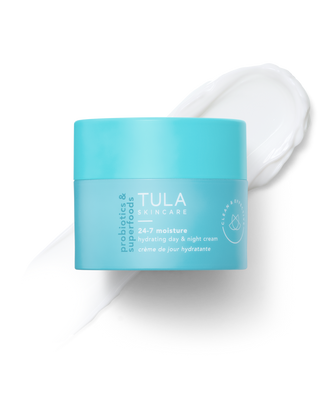
If you love 24-7 Moisture but want to skip the scent, 24-7 Moisture Fragrance-Free is the fragrance-free option. It’s a lightweight, non-greasy cream that’s formulated with prebiotics to help nourish the look of your skin while it works to support your barrier. It’s non-comedogenic, so it won’t clog pores, and it’s gentle enough for even the most reactive skin types. Apply it on clean skin after your serum or treatment step, morning and night, then follow with eye care and SPF during the day.
As you build out the rest of your routine, look for the same qualities at every step: fragrance-free, gentle and simple.
FAQs
Can you become allergic to a fragrance you’ve used for years?
Yes. Contact allergies develop gradually through repeated contact with a substance, so a product you’ve used happily for years can start causing a reaction. Scents are one of the common triggers. If a long-time favorite suddenly bothers your skin, a dermatologist’s patch test can help identify the ingredient responsible.
Does “hypoallergenic” mean a product is fragrance-free?
No. There are no federal standards or definitions for “hypoallergenic” on cosmetics, so brands can use the term without meeting a set definition or proving it to the FDA. That means it doesn’t guarantee a product is free from fragrance. Checking the ingredient list and choosing products labeled fragrance-free is a much more reliable approach.
Can fragrance in skincare cause breakouts?
Fragrance reactions and breakouts can look surprisingly alike. An allergic reaction to a skincare ingredient can leave skin red, itchy and swollen, which is easy to mistake for a breakout. If bumps appear only where you’ve applied a new scented product, pausing that product is a sensible first step, and a dermatologist can help if it continues.
Should people with sensitive skin avoid perfume and scented body care too?
It can help. The same kinds of fragrance ingredients used in skincare also show up in perfume, body lotion, shower gel and laundry products. If your skin is reactive, fragrance-free body care and laundry detergent are easy swaps.
Fragrance-Free, Simplified: The TULA Way
Caring for reactive skin doesn’t have to be complicated. At TULA, we make fragrance-free versions of some of our most-loved formulas, like 24-7 Moisture and The Cult Classic cleanser, so you don’t have to choose between the products you love and how your skin feels.
Start with fewer products, choose fragrance-free formulas where it counts most, and add anything new one step at a time. When you’re ready to build a simpler routine, explore TULA’s skincare for sensitive skin to find gentle options for every step, or take our skin quiz if you’d rather we point you in the right direction.


